
Limited vs Full Power of Attorney in a Joint Development Agreement: How Much Authority Should a Landowner Give the Developer?
•

Written by
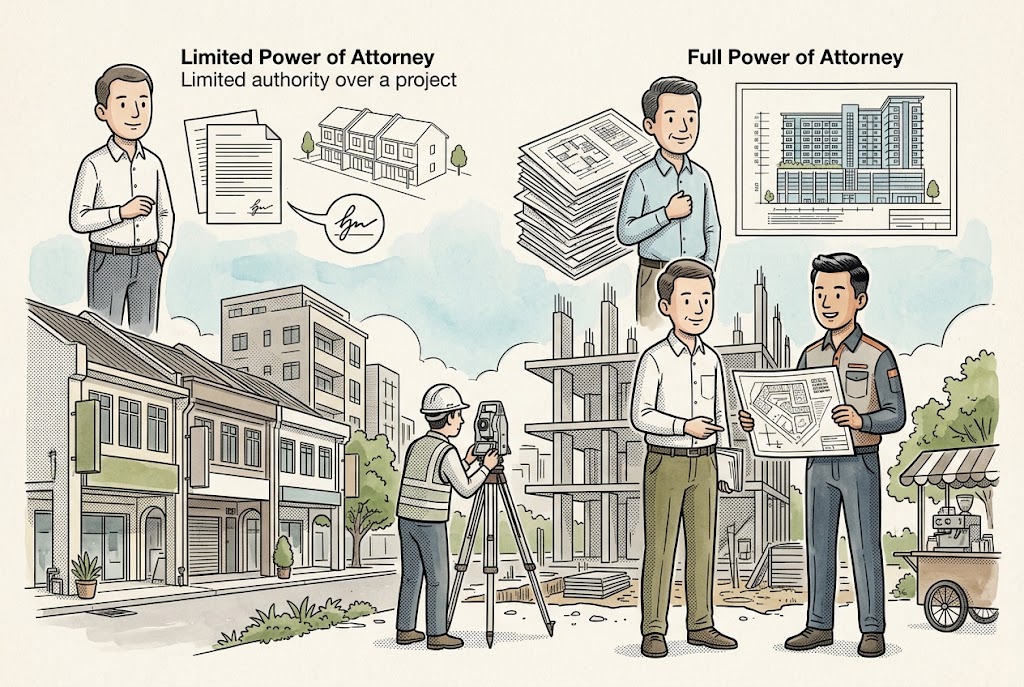
A power of attorney can solve a real problem in a joint development agreement: the developer needs to keep the project moving, but many approvals and land-related steps still depend on the landowner.
The danger is solving that practical problem with an instrument that gives away far more authority than the project actually needs.
A developer may say it needs a "full power of attorney" so it does not have to chase the proprietor for every signature. A landowner may respond by insisting on a "limited power of attorney". Those phrases are useful commercial shorthand, but they are not the safest way to draft the legal authority.
The better question is: what exact acts must the developer be able to perform, for how long, and which acts must remain under the landowner's control?
"Limited" and "full" are shorthand — the legal questions are scope and revocability
Current Malaysian court guidance describes a power of attorney as authority that can be given generally or specifically. It also distinguishes between revocable and irrevocable powers.
That matters because the phrase "limited POA" does not tell you enough. Limited to what? A "full POA" is even less useful if nobody has identified whether it includes planning submissions, receipt of authority notices, execution of financing documents, sale, transfer, charging or other dealings with the land.
In a JDA, the instrument should be read act by act rather than label by label.
Why does a developer ask for a POA?
The request is often driven by project administration rather than an intention to control the land.
A developer may need to coordinate planners, architects and engineers, submit applications, collect approvals, answer authority queries and execute recurring forms. If the registered proprietor has to personally sign every routine document, a project can lose time whenever the landowner is unavailable, slow to respond or operating through several corporate approval layers.
That can justify considering a POA.
It does not automatically justify giving the developer authority over the land itself.
Start by listing the acts the project genuinely needs
A specific project POA should begin with the development process, not with a generic precedent.
Depending on the site and the applicable authority requirements, the permitted acts might include:
signing and submitting identified planning or technical forms where representation is legally permitted;
corresponding with the relevant local authority or technical agencies;
collecting approvals, letters and notices;
providing or lodging defined project documents;
making routine amendments or responses within an approved development brief;
obtaining copies of records or approvals relevant to the project; and
doing administrative acts expressly connected with the JDA and the identified land.
Each power should have a purpose. If nobody can explain why a power is required to develop the site, it should not be included merely because it appears in a broad-form precedent. Our guide to Kebenaran Merancang risk allocation inside a JDA covers the planning-submission side of this authority in more detail.
Express exclusions are as important as the powers granted
A landowner should not rely on silence to preserve control over high-risk acts.
If the developer is not intended to have authority to sell, transfer, charge, lease or otherwise deal with the land, the POA should say so clearly.
Other matters that may warrant express exclusion unless separately negotiated include:
creating security over the land;
borrowing in the landowner's name;
receiving or redirecting the landowner's entitlement;
varying or terminating the JDA on the landowner's behalf;
surrendering title or agreeing to a land dealing outside the approved project structure;
appointing a substitute or sub-attorney without consent; and
settling disputes or compensation claims that materially affect the landowner.
The exact exclusions depend on the transaction. The drafting principle is simple: authority for approvals should not accidentally become authority for ownership decisions.
Specific authority usually aligns better with a JDA than a general power
A specific POA is easier to connect to the project sequence.
It can identify the land, the JDA, the categories of application and the permitted agencies or documents. That gives the developer usable authority while giving the landowner a clearer boundary.
A general power may be commercially requested where the project is complex and repeated actions are difficult to predict. But broader drafting creates broader interpretation and governance risk. The parties then need stronger controls around exclusions, reporting, document custody and duration.
The goal is not to make the POA so narrow that it fails every time a form changes. It is to make the purpose and outer boundary clear.
Revocable or irrevocable is a separate decision
Scope and revocability are not the same question.
A POA can be specific in scope but still be drafted as irrevocable in the circumstances permitted by law. A broader power may be revocable. The parties should therefore negotiate the two issues separately.
A developer may ask for irrevocability because it is spending money in reliance on the authority. It may not want the landowner to revoke the POA immediately after the developer has funded planning work, paid consultants or reached a critical approval stage.
The landowner should then ask: irrevocable for what acts, for what period and in support of what legitimate reliance?
Current Judiciary guidance explains that an irrevocable POA can have consequences beyond an ordinary revocable authority and is subject to the requirements of the Powers of Attorney Act 1949. It should therefore not be treated as a casual drafting choice.
Do not assume JDA termination automatically ends an irrevocable POA
This is one of the most important alignment points between the JDA and the POA.
The JDA may say that all authority ends on termination. But if the separate POA has been validly structured as irrevocable under the applicable law, the legal effect of the POA cannot safely be reduced to a single sentence in the commercial agreement.
The instruments need to be drafted together.
If the parties want the authority to exist only while the developer is performing, the lawyer drafting the documents should test whether that outcome is legally compatible with the chosen POA structure and the reliance the developer is being given. Our separate guide covers what happens when a JDA developer delays, defaults or becomes insolvent — including how an outstanding POA needs to be dealt with as part of that unwind.
Build an objective duration into the authority
A project POA should not remain in circulation indefinitely simply because nobody remembered to cancel it.
The duration can be tied, where legally appropriate, to identifiable events such as:
the expiry of an agreed fixed period;
the end of a particular approval phase;
completion of the development;
a defined long-stop date;
replacement by a new instrument; or
termination or another event to the extent that the chosen POA structure permits that consequence.
The JDA should also require the return of originals and copies, cessation of use, delivery of a list of outstanding applications and cooperation with cancellation or notification procedures where required.
What happens if the developer defaults or becomes insolvent?
The risk of an overbroad POA becomes most obvious when the parties are no longer cooperating.
If the developer is in default, the landowner needs to know whether the authority can be suspended, revoked or otherwise brought to an end and what formal steps must be taken. If the developer is insolvent, the landowner also needs to understand who controls the original instrument and whether any financier or third party claims rights connected with the project.
The JDA should therefore coordinate:
notice of default;
any cure period;
the status of the POA during that period;
revocation or termination steps where legally available;
return of the original instrument;
notification to relevant authorities or registries where required; and
any agreed financier step-in rights that affect the timing.
A POA should not become an orphan document after the commercial relationship has failed.
Execution, stamping and registration are not optional drafting details
For Peninsular Malaysia, the official Judiciary guidance on the Powers of Attorney Act 1949 identifies formal requirements relevant to a registrable POA, including proper execution, permitted language, stamping and registration at the High Court of Malaya.
LHDN's current stamp-duty guidance also lists a power or letter of attorney as an instrument subject to fixed stamp duty.
Land procedures can add another layer. JKPTG guidance for certain land applications expressly requires a POA used by a proprietor's representative to be registered at the High Court and Land Office. That does not mean every possible JDA act has an identical Land Office procedure, but it is a reminder that the land-side requirements must be checked for the actual dealing the attorney is expected to perform.
A POA does not let the developer bypass the law
A power of attorney is authority to act for the donor. It is not a licence to ignore planning, land, corporate or consent requirements.
If a transfer requires a particular consent, the attorney cannot make the consent requirement disappear. If the title is charged and the relevant dealing requires the chargee's involvement, the POA does not remove that issue. If an application requires a particular qualified submitting person, document or approval, the developer still has to comply with that process.
The same principle applies to restrictions inside the JDA. The developer should not be able to use a broadly worded POA to do indirectly what the commercial agreement says requires landowner approval.
Should the POA be inside the JDA or a separate document?
Often, the cleaner structure is a separate POA that is expressly required by and coordinated with the JDA.
The JDA can state when the landowner must execute it, the purpose it serves, the approved form, who bears stamping and registration cost, when the developer may use it and how it interacts with default or termination.
The separate instrument can then contain the formal grant of authority in a form capable of satisfying the legal and registration requirements applicable to that POA.
This also makes it easier to control amendments. A change to the commercial JDA does not automatically rewrite a registered authority instrument unless the parties intentionally do so.
POA checklist for a joint development agreement
Purpose: identify the project bottleneck the POA is intended to solve.
Land and agreement: connect the authority to the identified site and JDA.
Permitted acts: list the planning, technical or administrative acts the developer may perform.
Exclusions: state clearly which sale, transfer, security, financing or ownership decisions remain with the landowner.
Specific or general: choose the scope deliberately rather than relying on the phrase "limited" or "full".
Revocable or irrevocable: test the legal and commercial consequences separately from scope.
Duration: use objective periods or project events where legally appropriate.
Sub-delegation: state whether another person may be appointed to exercise the authority.
Records: require copies of material documents signed or submitted under the POA.
Default: coordinate cure, suspension, revocation/termination steps and return of originals.
Financier interface: make any lender step-in arrangement consistent with the POA.
Formalities: check execution, language, stamping, High Court registration and any land-procedure requirements that apply to the intended act.
Frequently asked questions
Is there a legal difference between a "limited" and "full" power of attorney in Malaysia?
Those expressions are commonly used commercially, but official Malaysian court guidance describes powers as general or specific and also distinguishes revocable from irrevocable powers. The actual clauses granting authority are more important than the label.
Can a landowner give a developer an irrevocable POA?
An irrevocable POA can be used where the legal requirements are satisfied, but it has different consequences from an ordinary revocable authority. The project documents should be drafted together so the intended duration and effect are legally coherent.
Does a POA need to be stamped and registered?
For a POA administered under the Powers of Attorney Act 1949 in Peninsular Malaysia, current Judiciary guidance identifies stamping and High Court registration as part of the relevant formal process. LHDN also treats a power or letter of attorney as a stamp-duty instrument.
Can a developer use a POA for planning applications?
A POA may form part of the authority structure for defined project submissions where the applicable procedure allows representation, but the exact planning and proprietor requirements still need to be satisfied. The instrument should not assume that representation removes a statutory or authority requirement.
Can a POA authorise the developer to charge or transfer the land?
That depends on what the instrument actually grants and on the land-law, consent and registration requirements applicable to the proposed dealing. A landowner who does not intend to delegate those powers should exclude them expressly rather than rely on assumption.
What happens to the POA when the JDA is terminated?
The answer depends on the terms and legal character of the POA. A revocable authority and a legally irrevocable authority may not end in the same way. The JDA should therefore include the agreed termination process without assuming it can override the legal effect of the separate instrument.
Does the Powers of Attorney Act 1949 apply throughout Malaysia?
Current Judiciary guidance states that the Act 424 administration described by the High Court POA registry applies in Peninsular Malaysia. Advice should be taken on the applicable regime for a project outside that territorial framework.
For the wider transaction structure, see our guide to joint development agreements in Malaysia.
This article is for general information only and does not constitute legal advice. Every transaction and every set of facts is different. Obtain specific advice from a qualified adviser before acting on any part of it.
Legal That Works advises landowners and developers on drafting and coordinating joint development agreements, including project authority, approvals, financing, landowner protections and default mechanics.
Disclaimer
The content provided on this website is intended for general informational and educational purposes only. It does not constitute legal advice, nor should it be relied upon as a substitute for professional consultation with a qualified lawyer. Every legal matter is unique, and you are strongly encouraged to seek tailored legal advice from a licensed legal practitioner before taking any action based on the information available here.
While we endeavour to ensure the accuracy and timeliness of the content, ASCOLAW and its affiliates make no representations or warranties of any kind, express or implied, about the completeness, accuracy, reliability, suitability or availability of the information contained on this website. Any reliance you place on such information is strictly at your own risk.
Author
AKMAL SAUFI MOHAMED KHALED
Managing Partner & Founder
Practice Area
Corporate Real Estate
Real Estate
Commercial
Business Function
Related Post
Developer Delay, Abandonment or Insolvency Under a Joint Development Agreement: What Can the Landowner Do?
Due Diligence Before a Joint Development Agreement: What the Landowner and Developer Must Check
Financing a Joint Development Project: How to Protect the Landowner While Giving the Developer Bankable Security
Joint Development Agreement for Developers in Malaysia: What to Lock Before Developing on Someone Else's Land
Joint Development Agreement Malaysia: Structure, Cost and What the Landowner Must Negotiate
Joint Development Agreement vs JV Company: Which Structure Should a Landowner and Developer Use?
Kebenaran Merancang (KM) in a Joint Development Agreement: Who Controls the Approval and Who Bears the Risk?
Landowner Entitlement Under a Joint Development Agreement: Units, Revenue Share, Profit Share or Guaranteed Minimum?
Limited vs Full Power of Attorney in a Joint Development Agreement: How Much Authority Should a Landowner Give the Developer?
Stamp Duty on a Development Agreement in Malaysia
